
UAE Nanny Salary & Hiring Report 2026 | Yaya Middle East
By Rui Pinto, Founder and CEO, Yaya Middle East | Last updated: 6 October 2026 | October 2026 edition. Covers nannies approved and families who joined between 1 April and 30 September 2026, compared with October 2025 to March 2026. Media enquiries: marilena@yayamiddleeast.com
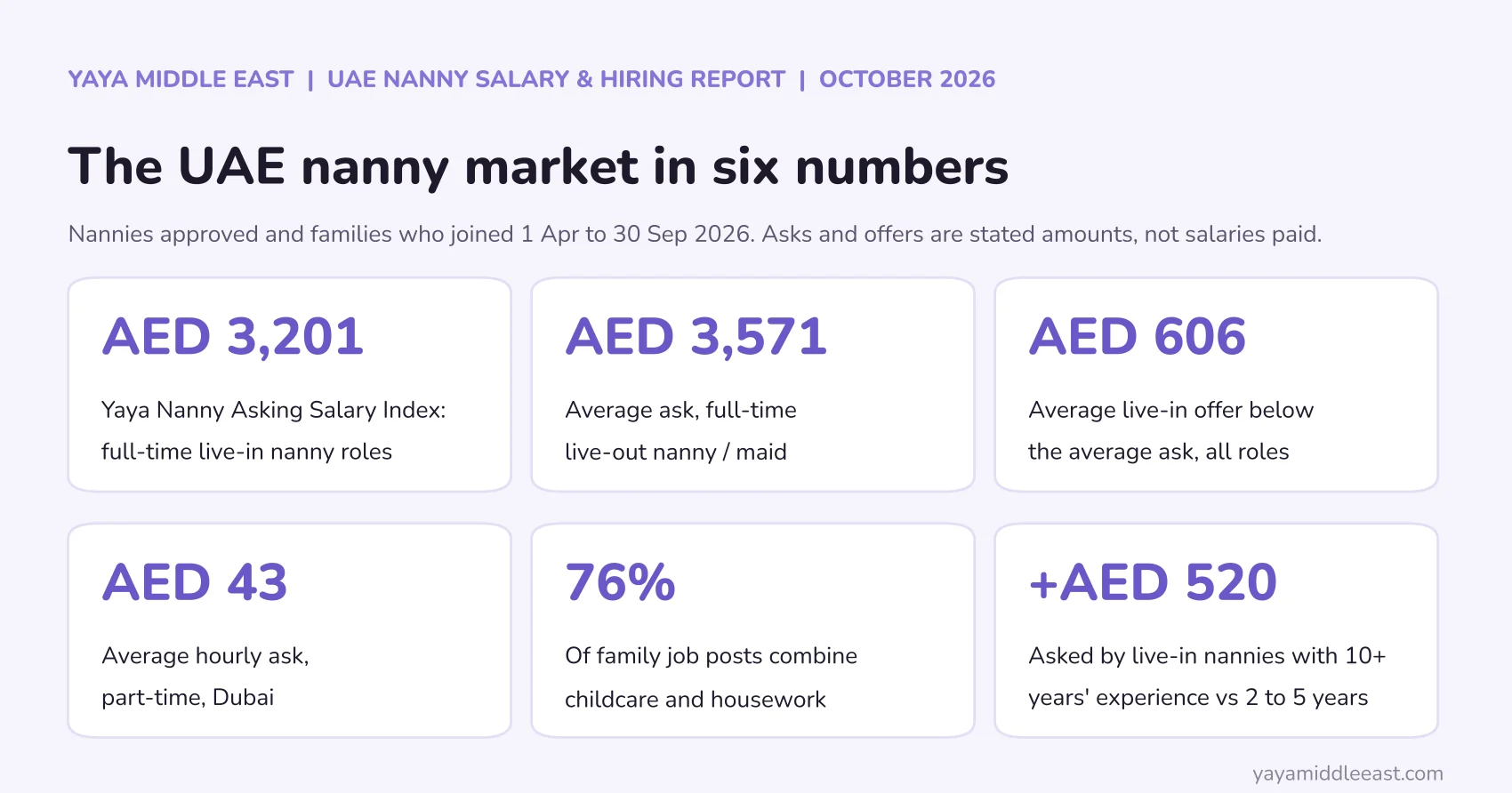
Short answer: Nannies approved on Yaya Middle East between April and September 2026 asked an average AED 3,201 a month for full-time live-in nanny work, measured at the midpoint of each nanny’s salary range. This is the Yaya Nanny Asking Salary Index. Across all live-in roles, families who joined in the same period offered an average of about AED 600 a month less than nannies asked.
Three findings to quote:
- Nannies approved on Yaya Middle East between April and September 2026 asked an average AED 3,201 a month for full-time live-in nanny work (the Yaya Nanny Asking Salary Index, an asking salary, not a salary paid).
- Three in four family job posts on Yaya Middle East between April and September 2026 (76%) were for a nanny / maid, a role that combines childcare and housework.
- Full-time live-in nannies approved on Yaya Middle East between April and September 2026 with more than 10 years’ experience asked about AED 520 (18%) a month more than those with 2 to 5 years.
Also notable: full-time live-in nannies with a driving licence asked about AED 650 (20%) a month more than those without, among nannies approved on Yaya Middle East between October 2025 and September 2026.
This is the UAE Nanny Salary & Hiring Report from Yaya Middle East, our six-monthly look at nanny salaries and hiring in the UAE, built from first-party data on the Yaya Middle East platform, where families hire nannies, maids and caregivers directly. It shows what nannies ask, what families offer, who the nannies and families are, which services families want, which benefits they list, and when families sign up.
Three things to know before you read the numbers. An ask is the monthly salary a nanny says she wants; an offer is what a family says it will pay. Neither is a salary actually paid. Most nannies and families state a range, so we use the midpoint of each range and apply the same salary calculation to both nannies and families. We lead with the average and show the typical range (the middle half of asks or offers) beside it. Unless a figure says otherwise, it covers every nanny approved and every family that joined during the six months, whether or not they are still searching, with asks and offers read on 6 October 2026. How we calculated each figure is explained in the methodology at the end.
Jump to: Key figures | Salaries by job type | By role | By city | Which nannies ask more | Nationality | What families want | Benefits | Nanny profiles | Seasonality | What changed | Methodology | FAQ
Key figures: the UAE nanny market, October 2026
All key figures cover nannies approved and families who joined Yaya Middle East between 1 April and 30 September 2026, UAE, unless marked otherwise.
| Measure | Figure | Who it covers |
|---|---|---|
| Yaya Nanny Asking Salary Index (average monthly ask) | AED 3,201 (typical AED 2,750 to 3,500) | Nanny / maid and nanny / caregiver, full-time live-in |
| Average monthly ask, full-time live-out | AED 3,571 (typical AED 3,250 to 3,900) | Nanny / maid |
| Average monthly offer, full-time live-in | AED 2,603 (typical AED 2,250 to 2,950) | All roles |
| Gap between average live-in ask and offer | AED 606 a month | All roles |
| Average monthly ask with a driving licence, full-time live-in | AED 3,853, about AED 650 (20%) more than without (AED 3,207) | Nanny / maid and nanny / caregiver, approved Oct 2025 to Sep 2026 |
| Experience premium, full-time live-in | AED 3,490 for more than 10 years against AED 2,970 for 2 to 5 years: about AED 520 (18%) more | Nanny / maid and nanny / caregiver |
| Average hourly ask, part-time, Dubai | AED 43 (typical AED 35 to 50) | All roles |
| Largest nanny nationalities | Filipino 51.2%, Ugandan 22.4%, Kenyan 10.1% | All roles |
| Most requested nanny nationality | Filipino, named by 64.6% of families | Families can name several |
| Family job posts for a nanny / maid (childcare and housework) | 76.0% | All families |
| Job posts mentioning 30 days’ annual leave | 40.4% (a legal requirement); 35.7% mention health insurance | Mentions in job posts, not benefits provided |
| Nannies open to negotiating salary | 78.7% | All roles |
Nanny salaries in the UAE by job type
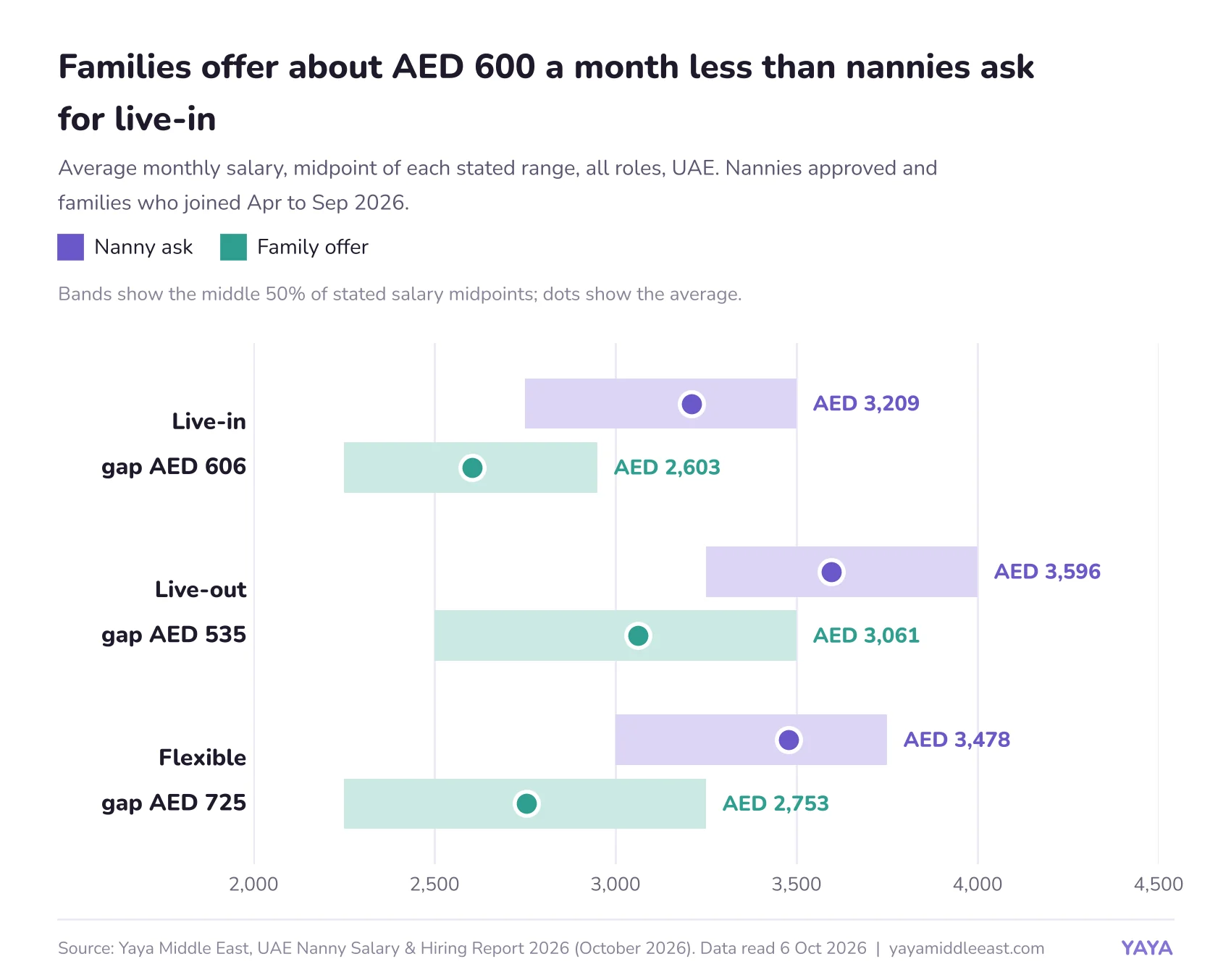
Families offer less than nannies ask for every full-time job type (all roles, midpoints, April to September 2026). For live-in roles, the average offer of AED 2,603 sat AED 606 below the average ask of AED 3,209. The gap was AED 535 for live-out roles (AED 3,061 against AED 3,596) and AED 725 for flexible roles (AED 2,753 against AED 3,478).
Most nannies are open to a conversation: 78.7% of nannies approved in the period marked their salary as negotiable. If your budget allows, offering closer to the asks in the table below gives you the widest choice.
| Job type (all roles, midpoints, Apr to Sep 2026) | Average ask | Typical ask | Average offer | Typical offer | Gap (ask above offer) |
|---|---|---|---|---|---|
| Full time, live-out | AED 3,596 | AED 3,250 to 4,000 | AED 3,061 | AED 2,500 to 3,500 | AED 535 |
| Full time, live-in | AED 3,209 | AED 2,750 to 3,500 | AED 2,603 | AED 2,250 to 2,950 | AED 606 |
| Full time, flexible | AED 3,478 | AED 3,000 to 3,750 | AED 2,753 | AED 2,250 to 3,250 | AED 725 |
| Part time, hourly (Dubai) | AED 43 an hour | AED 35 to 50 | Not reported | ||
Nanny and maid salaries by role
Most profiles on Yaya combine childcare and housework (nanny / maid). Dedicated nanny-caregivers and babysitters ask more on average than nanny / maids, maids on live-in ask the least, and drivers ask the most. Live-out nanny / maids ask about AED 370 (12%) a month more than live-in nanny / maids (AED 3,571 against AED 3,198). That compares asking salaries only: a live-in employer also provides accommodation and food, so compare the total cost when you choose between the two.
| Role and job type (midpoints, approved Apr to Sep 2026) | Average monthly ask | Typical ask |
|---|---|---|
| Nanny / maid, live-out | AED 3,571 | AED 3,250 to 3,900 |
| Nanny / maid, live-in | AED 3,198 | AED 2,750 to 3,500 |
| Nanny / maid, flexible | AED 3,459 | AED 3,000 to 3,750 |
| Nanny / caregiver, live-out | AED 3,733 | AED 3,250 to 4,000 |
| Nanny / caregiver, live-in | AED 3,247 | AED 2,750 to 3,700 |
| Maid, live-out | AED 3,499 | AED 3,250 to 3,750 |
| Maid, live-in | AED 3,096 | AED 2,750 to 3,500 |
| Babysitter, live-out | AED 3,646 | AED 3,250 to 4,000 |
| Driver / chauffeur, all job types | AED 4,612 | AED 4,000 to 5,250 |
Nanny salaries in Dubai, Abu Dhabi and Sharjah
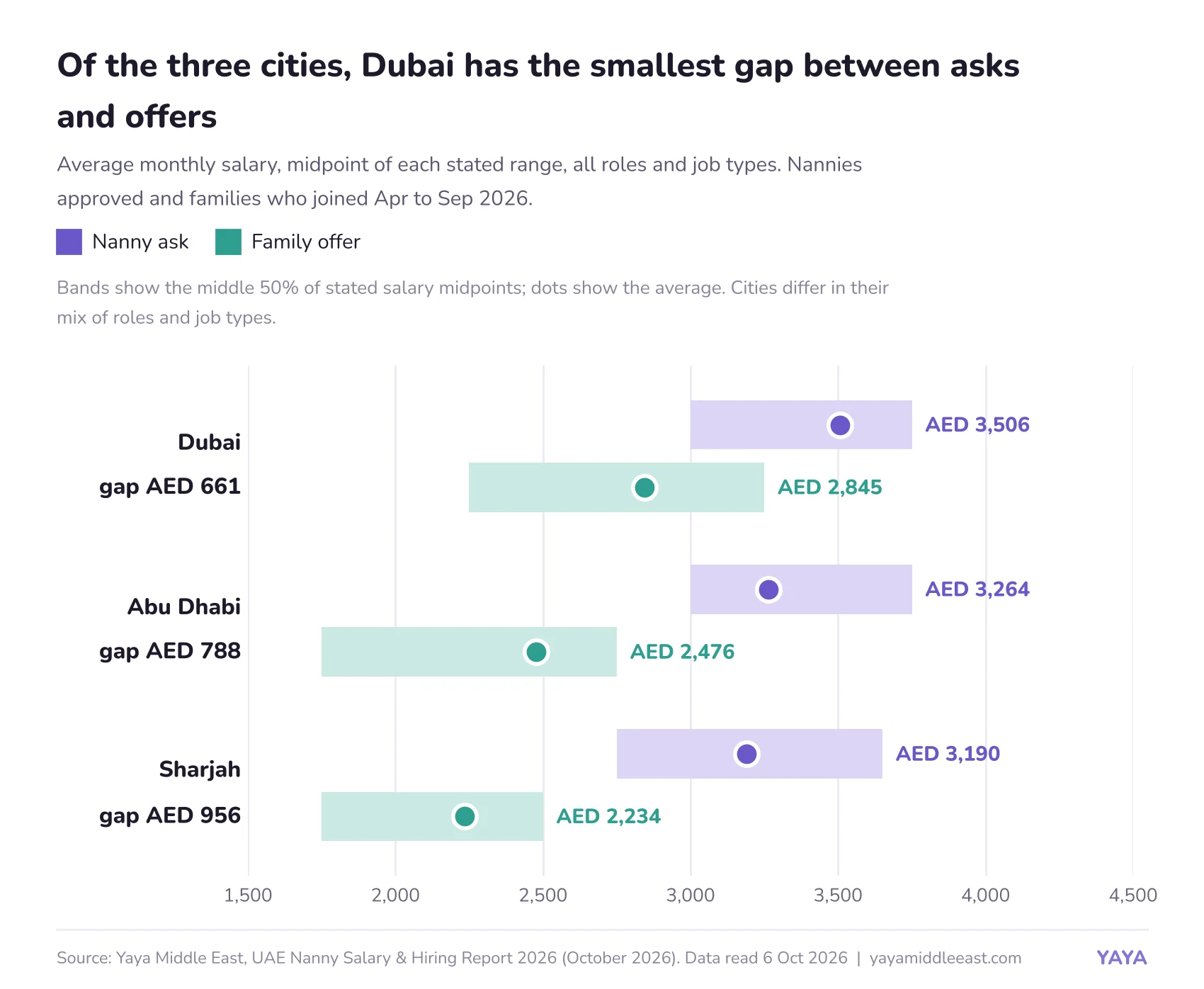
Dubai has the highest asks and offers, and the smallest gap between them: an average ask of AED 3,506 against an average offer of AED 2,845. The gap is wider outside Dubai: AED 3,264 against AED 2,476 in Abu Dhabi, and AED 3,190 against AED 2,234 in Sharjah. If you are hiring outside Dubai, expect nannies to ask well above what most local families offer. City figures pool all roles and job types, so compare cities with each other rather than with the live-in index.
| City (all roles, midpoints, Apr to Sep 2026) | Average ask | Typical ask | Average offer | Typical offer |
|---|---|---|---|---|
| Dubai | AED 3,506 | AED 3,000 to 3,750 | AED 2,845 | AED 2,250 to 3,250 |
| Abu Dhabi | AED 3,264 | AED 3,000 to 3,750 | AED 2,476 | AED 1,750 to 2,750 |
| Sharjah | AED 3,190 | AED 2,750 to 3,650 | AED 2,234 | AED 1,750 to 2,500 |
Which nannies ask for more in the UAE
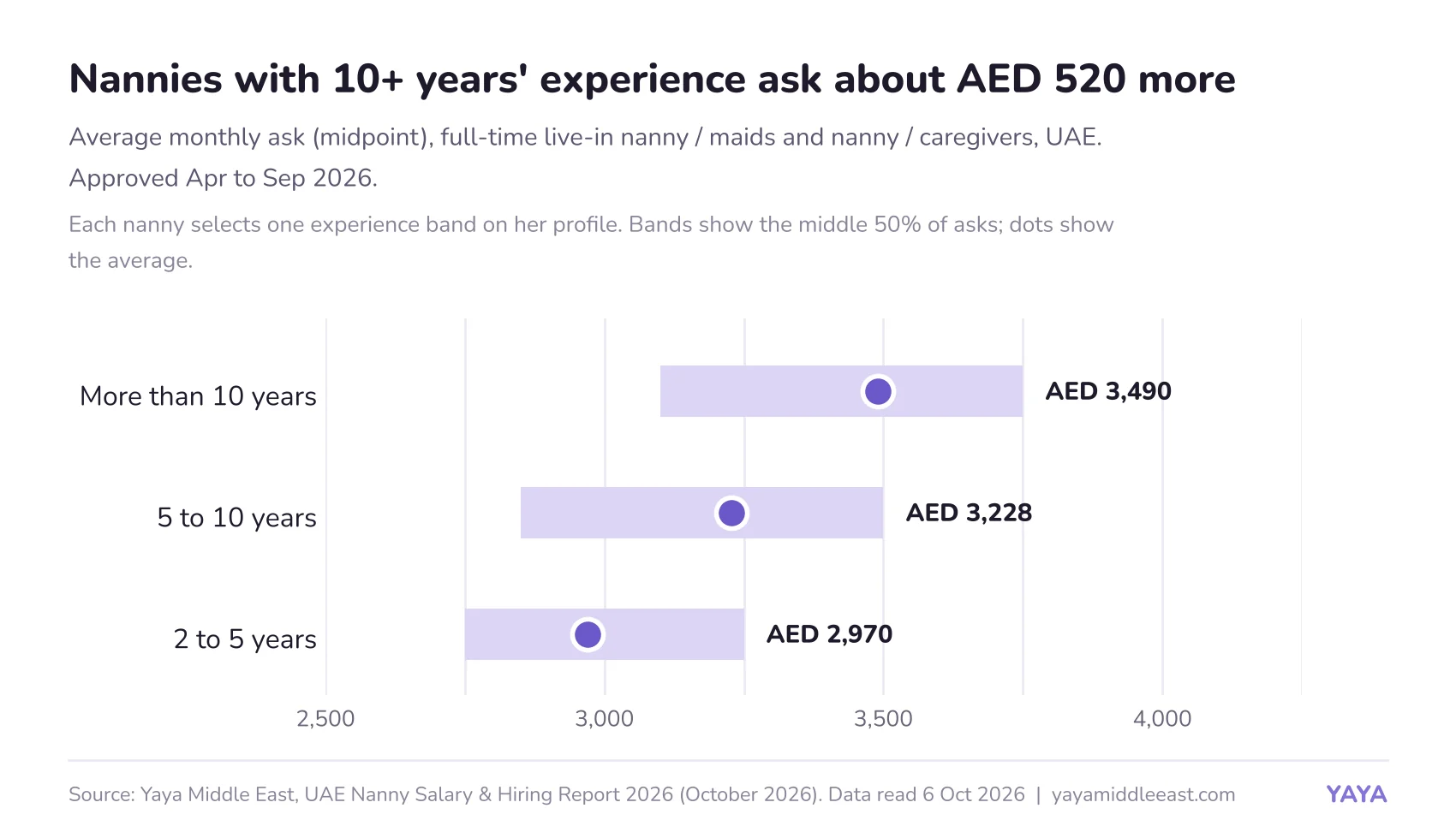
Nannies with more than 10 years’ experience ask about AED 520 (18%) a month more than those with 2 to 5 years. For full-time live-in nanny / maids and nanny / caregivers approved between April and September 2026, the average ask rises from AED 2,970 for 2 to 5 years’ experience to AED 3,228 for 5 to 10 years and AED 3,490 for more than 10 years. Average asks were almost identical with and without a certificate, and similar across individual skills. These are patterns in the data, not proof that one causes the other.
| Factor (nanny / maid and nanny / caregiver, full-time live-in, midpoints, approved Apr to Sep 2026) | Average ask | Typical ask |
|---|---|---|
| More than 10 years’ experience | AED 3,490 | AED 3,100 to 3,750 |
| 5 to 10 years’ experience | AED 3,228 | AED 2,850 to 3,500 |
| 2 to 5 years’ experience | AED 2,970 | AED 2,750 to 3,250 |
| Holds a certificate vs no certificate | Average asks almost identical | |
Nannies who list newborn care, cooking, tutoring or other individual skills asked about the same as the average live-in nanny, so ask for the skills you need.
Nannies with a driving licence
A driving licence is rare among nannies and is associated with a higher ask. Only 2.7% of nanny / maids approved between April and September 2026 hold one. Over the 12 months from October 2025 to September 2026, full-time live-in nanny / maids and nanny / caregivers with a driving licence asked an average AED 3,853 a month, about AED 650 (20%) more than those without (AED 3,207). If you need a nanny who can drive the children, budget for that difference.
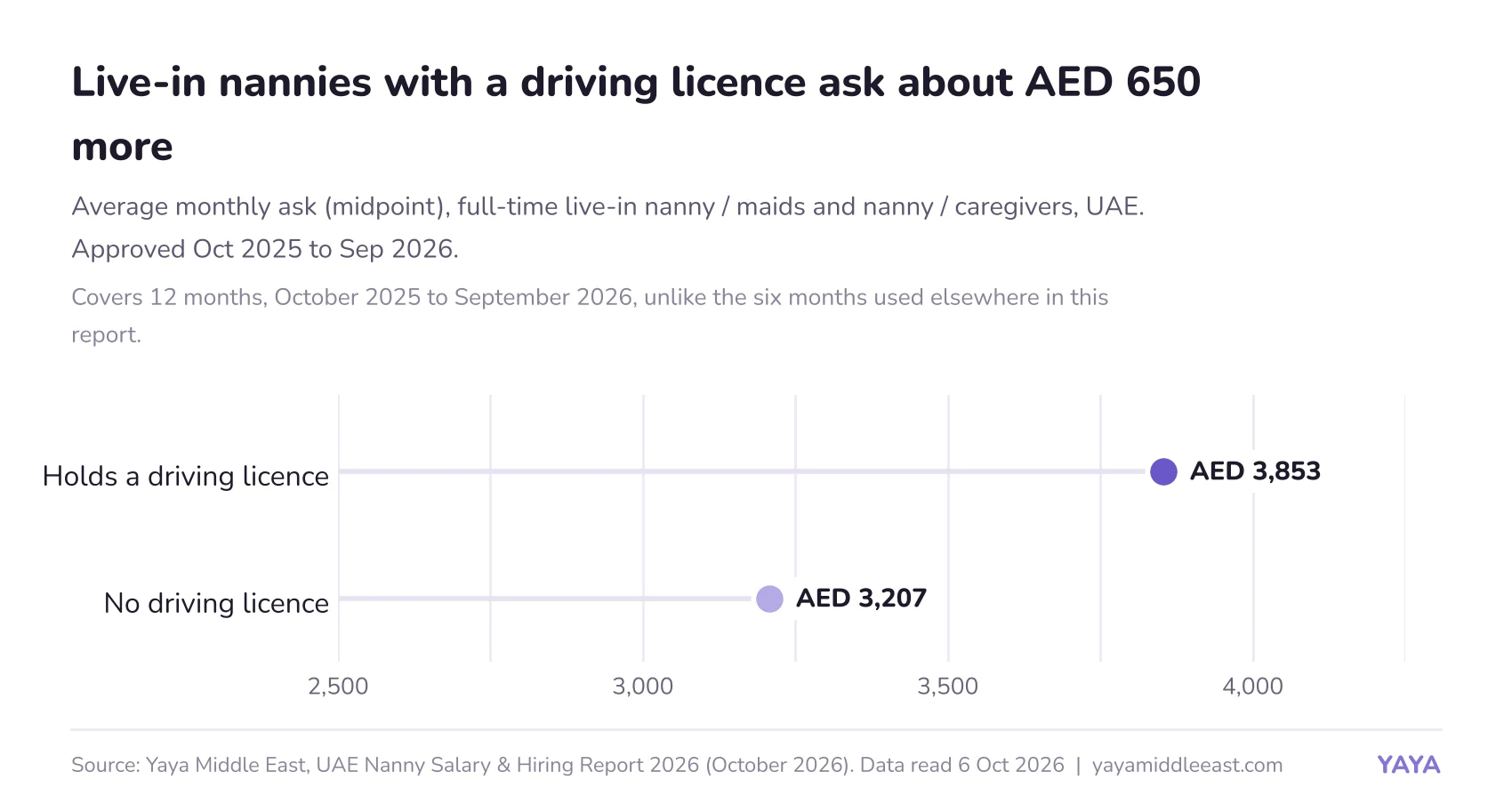
| Nanny / maid and nanny / caregiver, full-time live-in, midpoints, approved Oct 2025 to Sep 2026 | Average ask |
|---|---|
| Holds a driving licence | AED 3,853 |
| No driving licence | AED 3,207 |
| Difference | About AED 650 (20%) |
Nanny nationality and pay in the UAE
Half of the nannies approved on Yaya between April and September 2026 were Filipino (51.2%), followed by Ugandan (22.4%) and Kenyan (10.1%). Compared with the previous six months, the mix shifted towards Ugandan nannies (up from 19.5%) and away from Sri Lankan nannies (down from 5.6% to 3.9%).
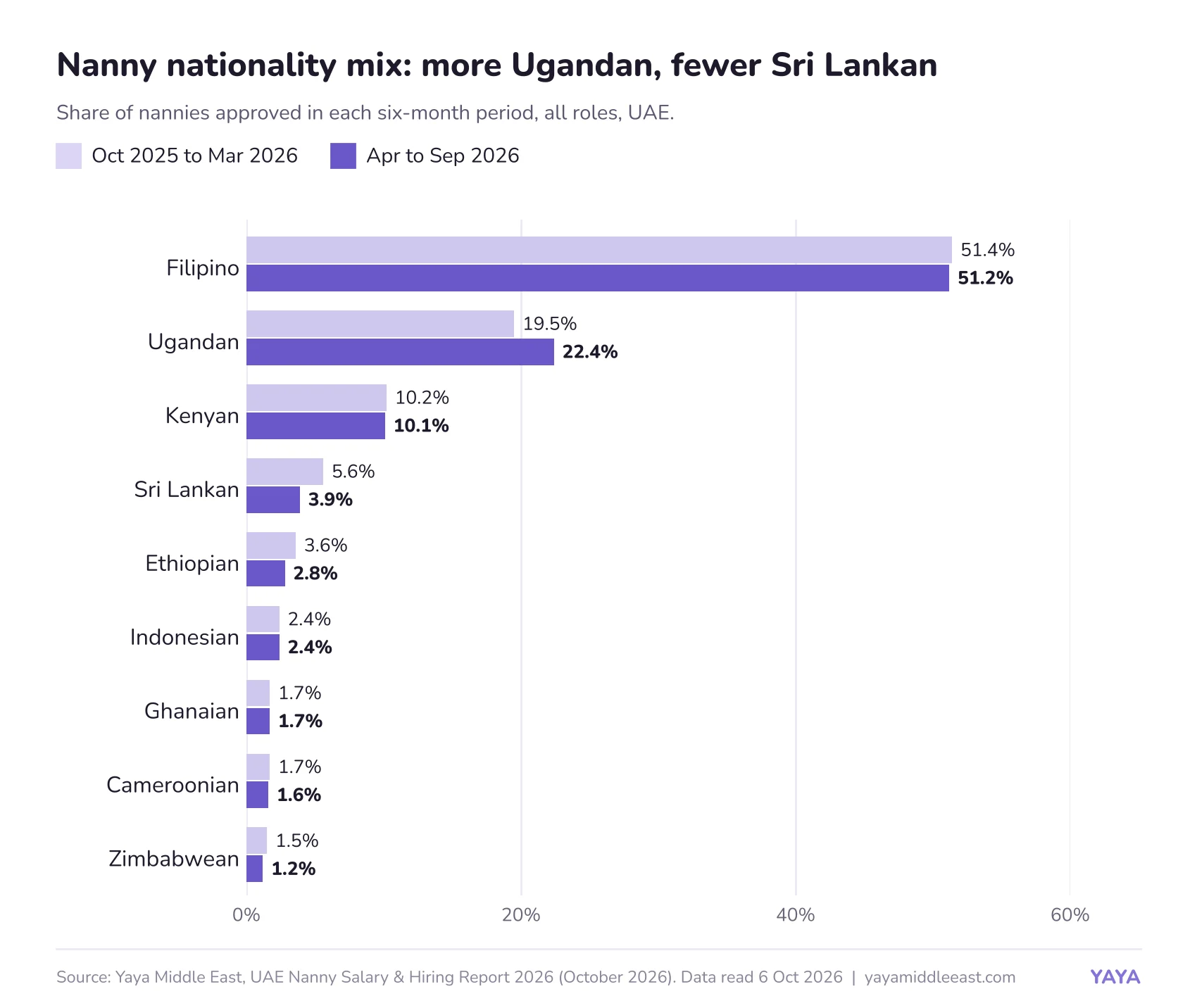
| Nanny nationality (all roles) | Approved Oct 2025 to Mar 2026 | Approved Apr to Sep 2026 |
|---|---|---|
| Filipino | 51.4% | 51.2% |
| Ugandan | 19.5% | 22.4% |
| Kenyan | 10.2% | 10.1% |
| Sri Lankan | 5.6% | 3.9% |
| Ethiopian | 3.6% | 2.8% |
| Indonesian | 2.4% | 2.4% |
| Ghanaian | 1.7% | 1.7% |
| Cameroonian | 1.7% | 1.6% |
| Zimbabwean | 1.5% | 1.2% |
78.4% of families who joined between April and September 2026 named one or more nanny nationalities they would prefer, and many named several. Filipino nannies were the most requested, named by 64.6% of families.
What nannies ask, by nationality
Comparing nannies on the same job type, Filipino and Indonesian nannies asked the most and Ugandan nannies the least (full-time, all roles, midpoints, nannies approved April to September 2026). For live-out work, Indonesian (AED 3,729) and Filipino (AED 3,722) nannies asked about AED 440 a month more than Ugandan nannies (AED 3,285). For live-in work, Filipino nannies asked an average AED 3,384 and Ugandan nannies AED 2,910, a difference of about AED 470. For every nationality where we can report both, live-in asks are lower than live-out asks.
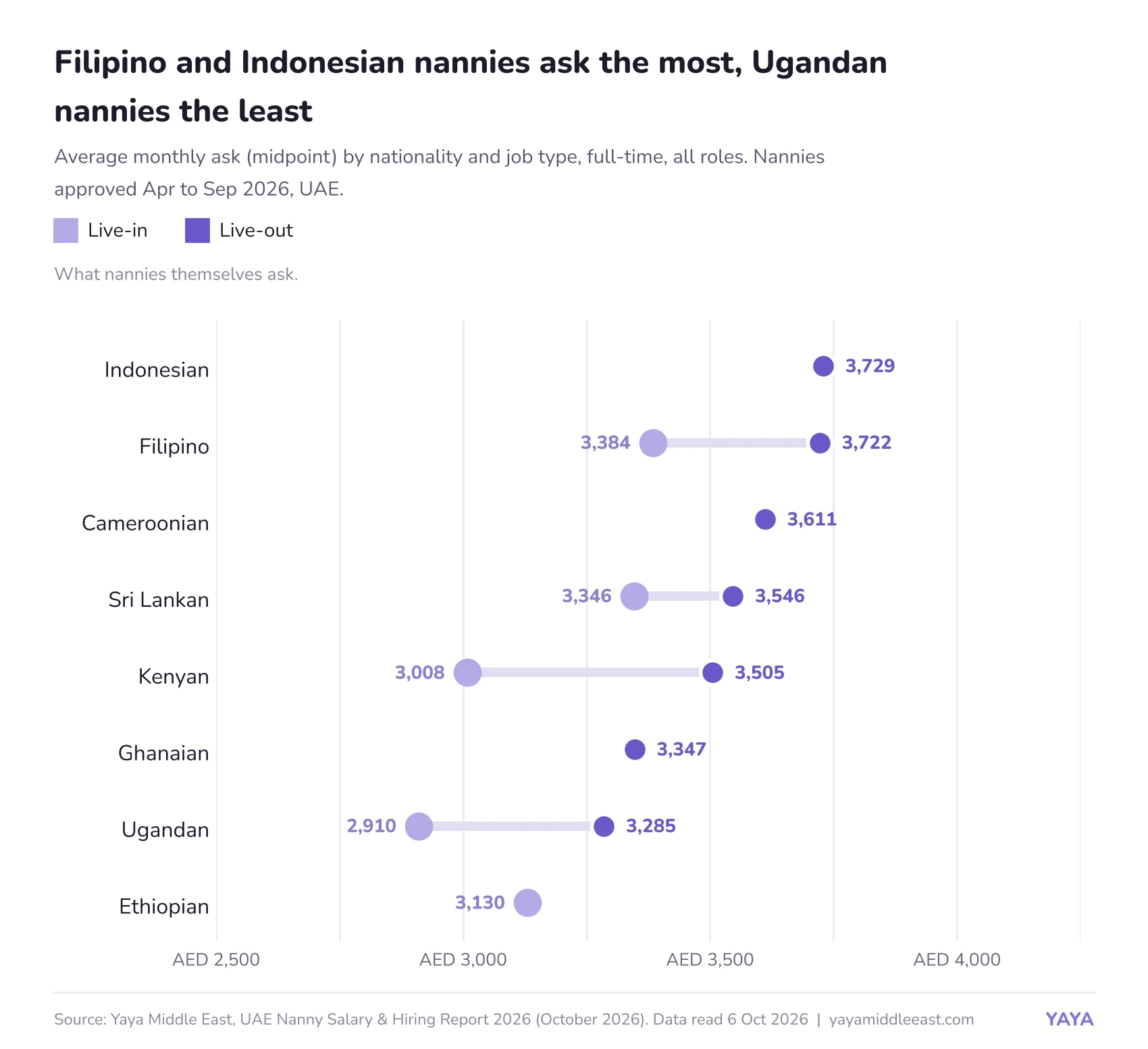
| Nanny nationality (all roles, midpoints, Apr to Sep 2026) | Full-time live-in, average ask | Full-time live-out, average ask | Full-time flexible, average ask |
|---|---|---|---|
| Filipino | AED 3,384 | AED 3,722 | AED 3,641 |
| Indonesian | – | AED 3,729 | – |
| Cameroonian | – | AED 3,611 | – |
| Sri Lankan | AED 3,346 | AED 3,546 | – |
| Kenyan | AED 3,008 | AED 3,505 | AED 3,270 |
| Ghanaian | – | AED 3,347 | – |
| Ugandan | AED 2,910 | AED 3,285 | AED 3,267 |
| Ethiopian | AED 3,130 | – | AED 3,492 |
What families are looking for
Three in four family job posts (76.0%) between April and September 2026 were for a nanny / maid, a role that combines childcare and housework, and 80.4% of families asked for cleaning. Most families on Yaya are hiring one person for both. Nearly half wanted a full-time live-in nanny, and most had one or two children.
| Families who joined Apr to Sep 2026, all roles | Share |
|---|---|
| Full time, live-in | 48.4% |
| Full time, live-out | 28.0% |
| Part time | 13.5% |
| Full time, flexible | 10.1% |
| Role: nanny / maid | 76.0% |
| Role: nanny / caregiver | 9.5% |
| Role: maid | 6.6% |
| One child in the household | 48.3% |
| Two children in the household | 26.9% |
| Minimum experience asked: at least 2 years | 35.5% |
| Minimum experience asked: at least 5 years | 27.2% |
| Minimum experience asked: at least 10 years | 2.1% |
Services families want
Cleaning was the service families asked for most: 80.4% of families who joined between April and September 2026 wanted it. Cooking (51.4%) and toddler care (51.2%) were each wanted by about half. On the nanny side, 91.4% of nannies approved in the same period listed cleaning, 80.3% toddler care and 44.2% cooking. The two sets of shares come from different groups, so they show how common each service is on each side, not whether there are enough nannies.
If cooking matters to you, ask about it in detail at interview.
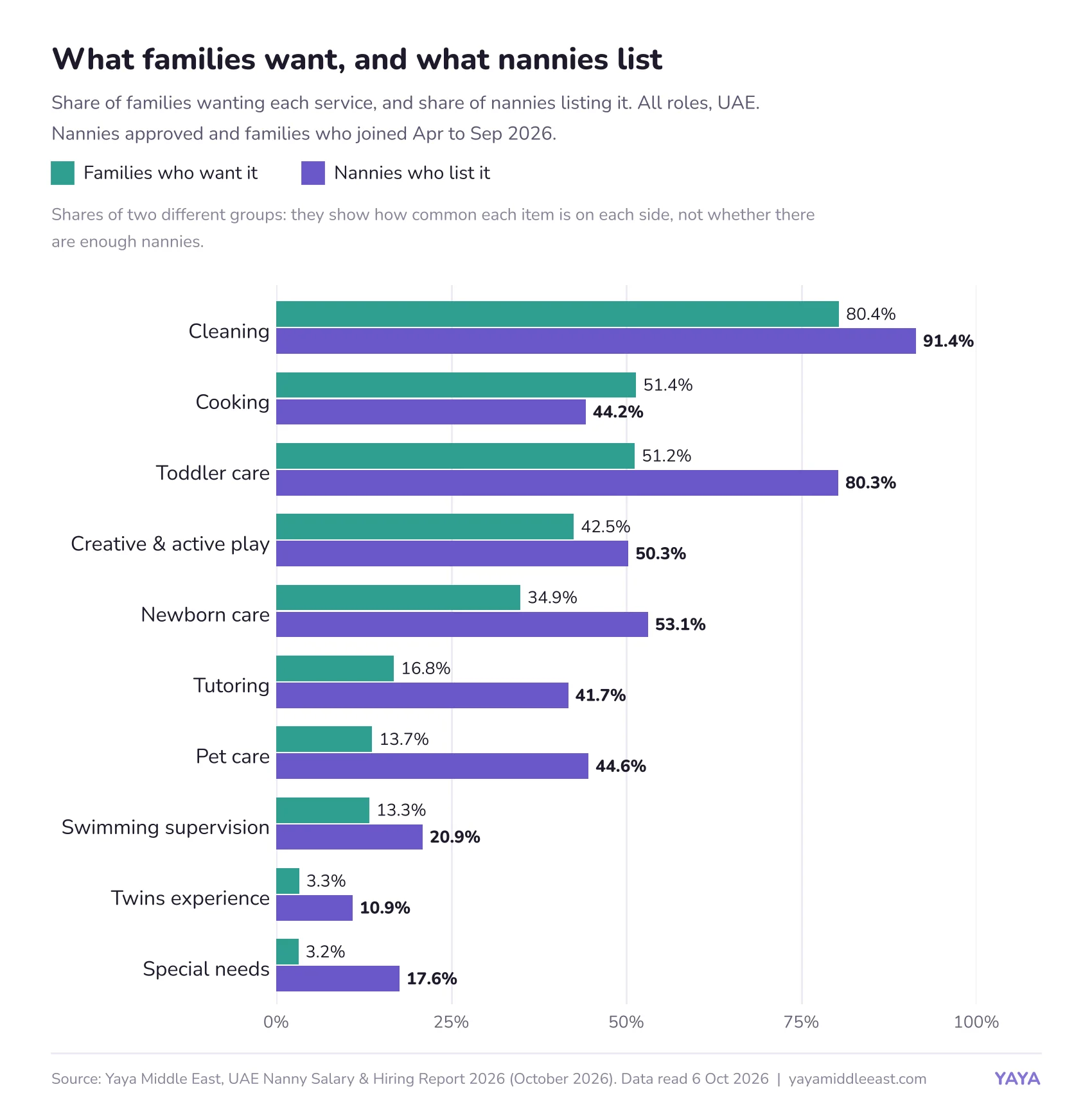
| Service or skill (all roles, Apr to Sep 2026) | Share of families wanting it | Share of nannies listing it |
|---|---|---|
| Cleaning | 80.4% | 91.4% |
| Cooking | 51.4% | 44.2% |
| Toddler care | 51.2% | 80.3% |
| Creative and active play | 42.5% | 50.3% |
| Newborn care | 34.9% | 53.1% |
| Tutoring | 16.8% | 41.7% |
| Pet care | 13.7% | 44.6% |
| Swimming supervision | 13.3% | 20.9% |
| Twins experience | 3.3% | 10.9% |
| Special needs | 3.2% | 17.6% |
Nanny benefits in the UAE: what the law requires
Free WiFi is the benefit families list most often, in 59.3% of job posts from families who joined between April and September 2026. But two items many families list as perks are legal requirements. Under the UAE’s domestic workers law, 30 days of paid annual leave and health insurance are owed whether or not a job post mentions them. 40.4% of posts list the leave and 35.7% list medical insurance. These figures count what job posts mention, not the benefits families go on to provide.
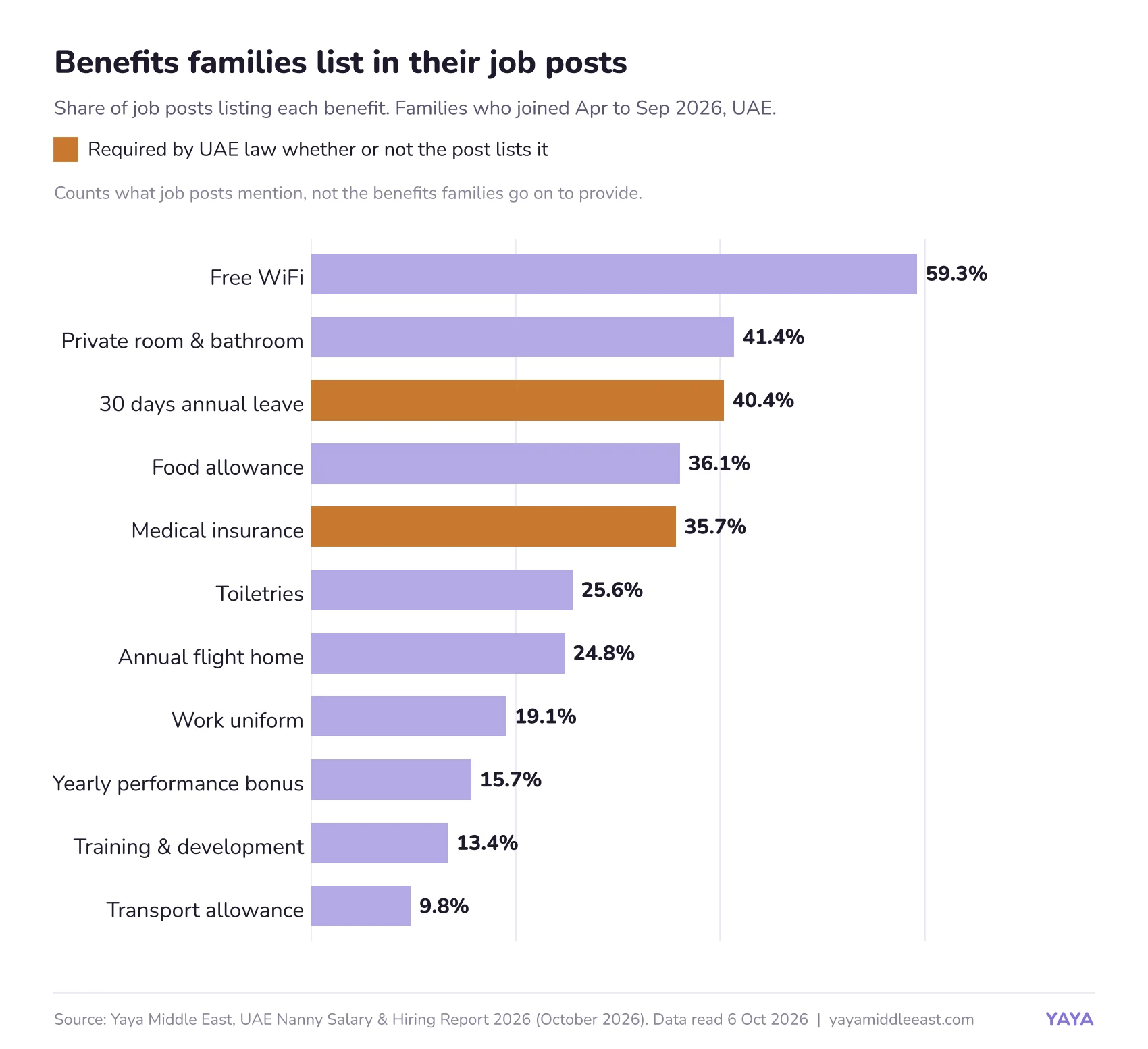
| Benefit | Job posts listing it (joined Apr to Sep 2026) | What UAE law says (Federal Decree-Law No. 9 of 2022) |
|---|---|---|
| 30 days’ annual leave | 40.4% | Required: 30 days’ paid leave for each year of service (Article 10) |
| Medical insurance | 35.7% | Required: employers must buy health insurance for a domestic worker to issue or renew her residence permit (nationwide since 1 January 2025) |
| Private room and bathroom | 41.4% | Suitable accommodation is required for full-time workers unless agreed otherwise (Article 11); a private bathroom is not |
| Food allowance | 36.1% | Food is required for full-time workers unless agreed otherwise (Article 11) |
| Annual flight home | 24.8% | The law requires a return ticket once every two years for leave at home (Article 10); yearly is above the minimum |
| Free WiFi | 59.3% | Not required |
| Yearly performance bonus | 15.7% | Not required |
The law also sets one paid rest day a week and at least 12 hours’ rest a day, 8 of them consecutive (Article 9). Sources: the Federal Decree-Law No. 9 of 2022 on Domestic Workers (MOHRE) the ILO summary of the UAE framework for migrant workers (May 2024) and, for health insurance, MOHRE (December 2024).
Nanny profiles: age, languages and education
Of nannies approved between April and September 2026, 45.3% are aged 25 to 34 and 36.7% are 35 to 44 (self-reported at signup). 99.3% listed English on their profile. Nearly all (99.6%) are women.
| Nannies approved Apr to Sep 2026, all roles, UAE | Share |
|---|---|
| Age 25 to 34 (self-reported at signup) | 45.3% |
| Age 35 to 44 (self-reported at signup) | 36.7% |
| Age 45 and over (self-reported at signup) | 14.9% |
| Lists English | 99.3% |
| Lists Tagalog | 37.8% |
| Lists Arabic | 30.4% |
| Secondary school is highest education | 59.8% |
| Community college | 18.9% |
| Bachelor’s degree | 14.0% |
| Comfortable with special needs | 22.9% |
When families and nannies sign up
New family sign-ups show when families start looking for a nanny. Between April and September 2026, family sign-ups on Yaya were slowest over the summer, lowest in July, then rose from August. September had the highest family sign-up level of the six months, 40% above the six-month average, while nanny sign-ups were 8% below it. Nanny sign-ups were highest in April and May. Family sign-ups also rose sharply in August and September 2025, so the late-summer rise looks seasonal. If your timing is flexible, starting your search before August puts you ahead of the late-summer wave of new families.
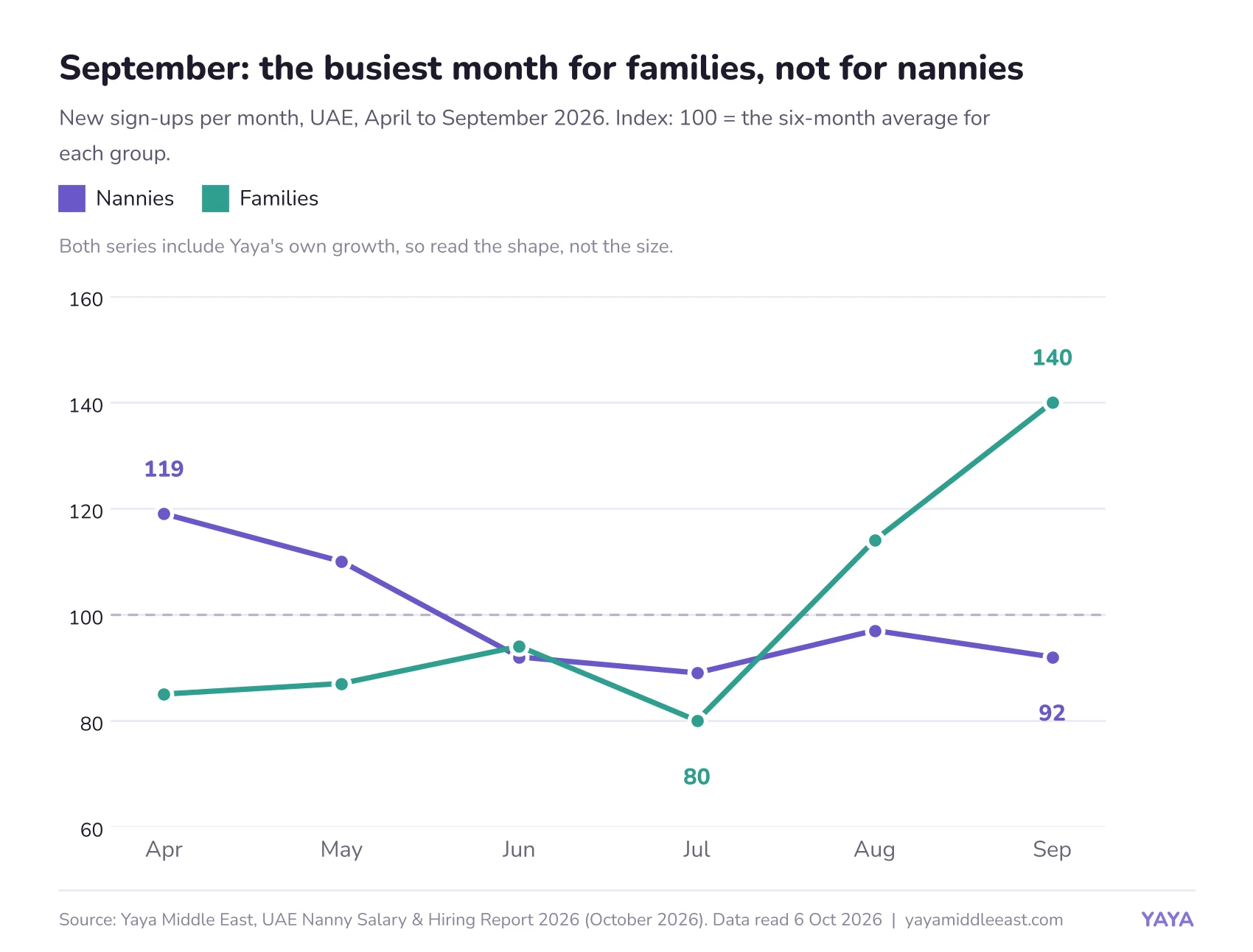
| Month (2026, UAE) | Nanny sign-up index | Family sign-up index |
|---|---|---|
| April | 119 | 85 |
| May | 110 | 87 |
| June | 92 | 94 |
| July | 89 | 80 |
| August | 97 | 114 |
| September | 92 | 140 |
Both series include Yaya’s own growth, so read the shape, not the size.
How this period compares with the previous six months
This compares two groups: nannies approved and families who joined between April and September 2026, and those approved or joined between October 2025 and March 2026. Both were read on 6 October 2026, so it is a comparison of the two groups, not a record of what the market looked like at the time. Earlier joiners have had longer to edit their profiles, so treat small differences with caution.
| Measure (UAE) | Oct 2025 to Mar 2026 | Apr to Sep 2026 |
|---|---|---|
| Asking Salary Index (average ask, live-in nanny roles) | AED 3,246 | AED 3,201 |
| Average ask, full-time live-in, all roles | AED 3,254 | AED 3,209 |
| Average offer, full-time live-in | AED 2,556 | AED 2,603 |
| Average offer, full-time live-out | AED 2,976 | AED 3,061 |
| Average offer, full-time flexible | AED 2,797 | AED 2,753 |
| Average ask, Dubai, all roles | AED 3,598 | AED 3,506 |
| Average offer, Dubai, all roles | AED 2,831 | AED 2,845 |
| Ugandan share of new nannies | 19.5% | 22.4% |
| Sri Lankan share of new nannies | 5.6% | 3.9% |
| Jobs listing medical insurance | 29.6% | 35.7% |
| Jobs listing 30 days’ annual leave | 36.3% | 40.4% |
| Jobs listing an annual flight home | 21.8% | 24.8% |
| Jobs that are full-time live-in | 45.0% | 48.4% |
| Jobs that are part time | 16.7% | 13.5% |
The later group of nannies asked slightly less on average, and the later group of families offered more for live-in and live-out roles, so the live-in gap was AED 606 for the later group against AED 698 for the earlier one. More of the later families’ job posts mentioned the leave and health cover the law requires, more of their jobs were full-time live-in, and more of the later nannies were Ugandan.
Methodology: how we calculated these figures
- Source: first-party data from the Yaya Middle East platform (app and web), UAE only, drawn from every nanny profile approved and every family profile created between 1 April and 30 September 2026, and a comparable data set for October 2025 to March 2026. Internal and deleted accounts are excluded and all data was anonymised.
- Who is counted: unless a figure says otherwise, it covers every nanny approved and every family that signed up between 1 April and 30 September 2026, whatever their status on 6 October 2026, including nannies who have since been hired and families whose job is filled. The comparison period is 1 October 2025 to 31 March 2026, counted the same way.
- Minimum sample: every average, range and index in this report is drawn from at least 30 profiles or jobs, and every share is calculated on a base of at least 30. Smaller groups are left out and shown as a dash. To reach that minimum, the driving licence comparison covers nannies approved between October 2025 and September 2026.
- Sample sizes: we publish bands rather than exact counts. The bands below give the number of profiles or jobs behind each main figure, after exclusions.
| Figure | Profiles or jobs behind it |
|---|---|
| Yaya Nanny Asking Salary Index (full-time live-in nanny roles) | 500 or more |
| Average asks by job type (live-in, live-out, flexible) | 500 or more each |
| Average family offers: live-in and live-out | 500 or more each |
| Average family offer: flexible | 100 to 499 |
| Asks by experience band | 100 to 499 each |
| Hourly ask, part-time, Dubai | 100 to 499 |
| City figures: Dubai | 500 or more |
| City figures: Abu Dhabi | 100 to 499 |
| City figures: Sharjah | 30 to 99 offers, 100 to 499 asks |
| Driving licence comparison (Oct 2025 to Sep 2026) | 30 to 99 with a licence, 500 or more without |
- Ask and offer: the midpoint of the monthly salary range a nanny states on her profile (ask) or a family states on its job (offer), or the single figure if only one is given. Ranges wider than AED 1,000 are left out: about one in ten profiles that state a salary, more for flexible roles. We apply the same salary calculation to both groups; the gap is a difference between group averages, and the groups can differ in role, experience and workload. Both were read as they stood on 6 October 2026, so figures for earlier joiners reflect any edits made since they joined. Neither is a salary actually paid.
- Averages and typical range: we lead with the average because asks and offers are mostly typed in steps of AED 500, so medians cluster on the same round numbers and hide real differences. The typical range is the middle half of asks or offers (25th to 75th percentile). Amounts of 0 count as not stated, and monthly asks under AED 500 or over AED 20,000 are treated as typing errors and excluded.
- Yaya Nanny Asking Salary Index: the average monthly ask (midpoint) of nanny / maid and nanny / caregiver profiles seeking full-time live-in work. It is a simple average of asking salaries, not adjusted for changes in the mix of profiles, and not a salary paid. This edition starts the series on the midpoint basis.
- Gap: the average ask minus the average offer for the same job type, in AED a month.
- Roles: unless a table names roles, figures pool every role, including maids, babysitters, drivers and cooks.
- Nationality preferences: the share of families who named each nationality as preferred on their job. Families can name more than one, so shares add up to more than 100%.
- Nationality and pay: nanny asks by nationality are compared within the same job type.
- Sign-up index: new sign-ups in each month divided by the average month in April to September 2026, multiplied by 100, calculated separately for nannies and families.
- Experience is the single band each nanny selects on her profile: 2 to 5 years, 5 to 10 years or more than 10 years (shown in the app as more than 2, 5 or 10 years). Age is self-reported at signup and not updated.
- Limits: these figures describe what families and nannies did on Yaya, which may differ from the wider market. Trends over time include Yaya’s own growth.
How to cite this report
Pinto, R. (2026). UAE Nanny Salary & Hiring Report 2026, October edition. Yaya Middle East. Nannies approved and families who joined between 1 April and 30 September 2026; figures read on 6 October 2026. https://www.yayamiddleeast.com/nanny-salary-report-uae-october-2026
When quoting a figure, please keep its period and the roles it covers, and call salaries “average asking salary” or “average offer” rather than a salary paid. You may reuse the charts and figures in this report with credit to “Yaya Middle East, UAE Nanny Salary & Hiring Report 2026” and a link to this page. 📊 Download the headline figures (CSV)
Media enquiries: marilena@yayamiddleeast.com. Author: Rui Pinto, Founder and CEO, Yaya Middle East.
Frequently Asked Questions
How much does a full-time nanny cost in the UAE?
On Yaya Middle East, full-time live-in nanny / maids and nanny / caregivers approved between April and September 2026 asked an average AED 3,201 a month (midpoint of their salary range), with the middle half asking AED 2,750 to 3,500. Full-time live-out nanny / maids asked an average AED 3,571. Families offered less: an average AED 2,603 for live-in roles, across all roles. Under UAE law, the employer also covers annual leave, medical care and, for full-time workers, accommodation and food unless agreed otherwise.
Is a live-out nanny more expensive than a live-in nanny?
On asking salary, yes. On Yaya Middle East, full-time live-out nanny / maids approved between April and September 2026 asked an average AED 3,571 a month, about AED 370 (12%) more than live-in nanny / maids (AED 3,198). A live-in employer also provides accommodation and food, so the total cost of a live-in nanny can be higher than the salary gap suggests.
How much is a nanny in Dubai per month?
In Dubai, nannies approved between April and September 2026 asked an average AED 3,506 across all roles and job types (midpoint of their salary range), with the middle half asking AED 3,000 to 3,750. Dubai families offered an average AED 2,845.
What is the hourly rate for a part-time nanny in Dubai?
Part-time profiles in Dubai, across all roles, approved between April and September 2026 asked an average AED 43 an hour, with the middle half asking AED 35 to 50.
What nationality are most nannies in the UAE?
On Yaya Middle East, 51.2% of nannies approved between April and September 2026 were Filipino, 22.4% Ugandan and 10.1% Kenyan. Among nannies approved in the previous six months, 19.5% were Ugandan.
Do nanny salaries in the UAE depend on nationality?
Asks differ by nationality even within the same job type. On Yaya Middle East, among full-time live-out nannies approved between April and September 2026, Indonesian (AED 3,729) and Filipino (AED 3,722) nannies asked the most on average and Ugandan nannies (AED 3,285) the least. For live-in work, Filipino nannies asked an average AED 3,384 and Ugandan nannies AED 2,910. These are asking salaries, not salaries paid.
Do nannies with certificates ask for higher salaries?
Not on average. Among full-time live-in nannies approved on Yaya Middle East between April and September 2026, average asks were almost identical with and without a certificate. Experience and a driving licence go with higher asks: the average rises from AED 2,970 for 2 to 5 years’ experience to AED 3,490 for more than 10 years, and nannies with a driving licence asked about AED 650 more than those without (October 2025 to September 2026).
When is the best time to hire a nanny in the UAE?
If your timing is flexible, before August. On Yaya Middle East, new family sign-ups were slowest over the summer of 2026 and rose from August, peaking in September at 40% above the six-month average. The same late-summer rise happened in 2025. Nanny sign-ups were highest in April and May.
How often is this report published?
Every six months. This October 2026 edition covers April to September 2026; the next will cover October 2026 to March 2027.
Key Takeaways
- The Yaya Nanny Asking Salary Index is AED 3,201: the average monthly ask (midpoint of each range) of full-time live-in nanny / maids and nanny / caregivers approved on Yaya Middle East between April and September 2026.
- Across all live-in roles, families who joined in the same period offered an average AED 2,603, about AED 600 a month below the average ask.
- Dubai had the highest average asks and offers and the smallest gap between them; in Abu Dhabi and Sharjah, offers sat further below asks.
- Nannies with more than 10 years’ experience ask about AED 520 (18%) more than those with 2 to 5 years, and live-in nannies with a driving licence asked about AED 650 (20%) more than those without (October 2025 to September 2026). Average asks were almost identical with and without a certificate.
- Three in four family job posts (76.0%) were for a nanny / maid combining childcare and housework. Live-out nanny / maids ask about AED 370 (12%) more than live-in, before accommodation and food.
- Half of nannies approved in the period were Filipino, and 64.6% of families named Filipino as a preferred nationality.
- Within the same job type, Filipino and Indonesian nannies asked the most and Ugandan nannies the least: about AED 440 a month apart for live-out work, and AED 470 between Filipino and Ugandan nannies for live-in work.
- Annual leave and health insurance are legal requirements, yet only 40.4% and 35.7% of job posts mentioned them.
- September had the highest family sign-up level of the six months; nanny sign-ups were highest in April and May.
Figures checked 6 October 2026 against Yaya Middle East platform data for 1 April to 30 September 2026. Legal points are taken from Federal Decree-Law No. 9 of 2022 on Domestic Workers (MOHRE) and the ILO’s May 2024 summary. This report is general information, not legal advice. Confirm employment rules with MOHRE or a licensed provider. Ready to start your search? Get the Yaya Middle East app.